THE LISTENING ROOM
Enjoy the latest recordings
from Naked Figleaf Press | Figmentum Books
Lempedu by Brina Calkins
First published in The Figlet Issue 6, Autumn/Winter 2026

Image courtesy of Brina Calkins
A stolen boat, a deserted pier and a dazzling smile lure us into Brina Calkins’ Lempedu, a disturbing tale of desire, danger and transformation. As attraction turns to obsession, the boundaries between pleasure and terror begin to dissolve. Through sharp, fragmented prose and vivid sensory detail, Brina explores the seductive power of the monstrous and the desire to surrender completely to another, even at the risk of losing oneself. A story in which seduction and consumption become one....
Brina Calkins (Sidhe/Her/Fey/They/It) is Queer in every Sphere; disabled (CFS & Fibro), neurodivergent (C-PTSD & AuDHD), non-binary trans femme, bi/pan lesbian, anarchist communist. Sidhe is a writer, mainly poetry and tabletop roleplaying game design (as Ratgrrrl Games), but fey enjoys all forms of creative writing, particularly exploring the intersection of visceral emotion, bodily viscera, and the surreal notion of identity.
For the women who were silenced, and those who still refuse to be.

Image by Karl Whitmore
Forget the broomsticks and pointy hats. The real witches were far more dangerous. They had opinions!
For Hallowe’en, I've recorded my poem 'How to Spot a Witch', from Wyuen Pyne: A Reckoning of Women's Voices.
A little history, a lot of misogyny, and absolutely no flying lessons required.
1487 saw the publication of The Malleus Maleficarum (The Hammer of Witches), a vicious handbook of misogyny that helped fuel centuries of persecution. Women could be accused, tortured and executed for almost anything. Their greatest crime? Daring to step outside the boundaries men had drawn for them.
Witchcraft was the accusation. Female autonomy was the threat.
For this and other poems, prose, images and essays exploring the centuries-long silencing, punishment and persecution of women—and the courage, defiance and resistance of those who refused to submit—discover Wyuen Pyne: A Reckoning of Women's Voices.
The Sky is Full of Bones by Jason Watts

Image by Jason Watts
The Sky is Full of Bones is a haunting prose poem that draws on Gothic horror and surrealist imagery to explore the boundaries between flesh, death and transcendence. Through its incantatory repetition, visceral language and shifting perspectives, the familiar night sky becomes a vast, unsettling anatomy. As the woman'a body responds to the irresistible pull of the heavens, the distinction between self and cosmos dissolves.
Jason Watts is a writer of weirdness and flash fiction who has somehow made it through six decades without showing it too much. He is currently to be found several feet underground, planning the downfall of mankind (see The Forest Knows the True Beast). His work has appeared in The Figlet and Brevity. Telling the Bees is available through Lemon Jelly Press. He is currently preparing material for his first full collection of writing, to be published by Figmentum.
'The Sky is Full of Bones' is published in The Figlet Issue Six, launched at the Isle of Wight Literary Festival in October 2026. Bringing together 72 Isle of Wight writers and illustrators, this issue explores the theme Fair or Foul through an eclectic mix of fiction, poetry, memoir, essays, humour and artwork.

Does evil really exist, or is it simply a convenient label for behaviour we find unacceptable?
In Crispin Keith's wickedly satirical short story Evil, a charismatic philosophy lecturer challenges his students to question everything they think they know about morality. But when the discussion takes an unexpected turn, his own convictions are put to the test.
Isle of Wight writer Crispin Keith spent nearly four decades teaching history before turning his talents to fiction. The author of political thrillers and short stories, his published novels include Shadow of a Shadow and his latest, Cache.
Evil is published in The Figlet, Issue Six, launched at the Isle of Wight Literary Festival in October 2026. Bringing together 72 Isle of Wight writers and illustrators, Issue Six explores the theme Fair or Foul through an eclectic mix of fiction, poetry, memoir, essays, humour and artwork.
Obic's Monologue by Hillard Morley

In Obic's Monologue, an extract from The Shadowing of Combfoot Chase, Obic denounces the way in which female beauty has been portrayed through the ages.
Rooted in concerns about surveillance capitalism and told in polyphonic, dark and witty episodes, The Shadowing of Combfort Chase reveals a society under threat. Thought-provoking, frightening and funny in equal measure, Hillard Morley's The Shadowing of Combfoot Chase asks us to consider the consequences of privacies being eroded through hyper-surveillance, and challenges us not to take our freedoms for granted.
Molly's Aria by Jean G-Owen
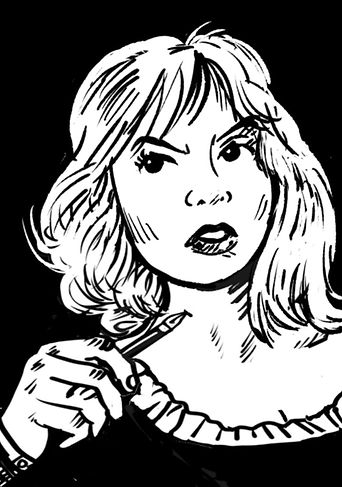
In celebration of Bloomsday, the day on which James Joyce set his great novel Ulysses, I'm sharing a monologue from my book, Wyuen Pyne: A Reckoning of Women's Voices. While many of the pieces in my book are reckonings from so-called witches, scolds, shrews, saints and other women punished publicly and cruelly for saying No, ‘Molly’s Aria’ is a response from Molly Bloom, wife of Leopold, who spends the entire novel abed while he mooches around that beautiful city. For years Molly Bloom has been renowned as one of literature’s great female voices. Yet whose voice are we really hearing: Molly’s, or Joyce’s idea of Molly. In this recording, I won’t attempt an Irish accent. Molly Bloom was raised in Gibraltar, after all, and perhaps that gives me a little poetic freedom.
(p.s. apologies for the sirens in the background!)
Molly Bloom by Karl Whitmore
Molly sings for the women who were reduced to chorus, footnote or final flourish. She sings for those who’ve spent a lifetime unpicking the fabric of who they were told to be. Here, Molly finally gets to say No. And it rings like a bell through the centuries of Yes.
...from 'Wyuen Pyne' by Jean G-Owen
Order your copy of Wyuen Pyne here.
The Glass Muse by Jean G-Owen

'The Glass Muse' is taken from my collection The Pain of Glass and draws on Virginia Woolf’s concept of women as mirrors, reflecting men’s greatness. The poem examines this dynamic between two women, using glass as a metaphor for the speaker’s identity under the weight of another’s expectations. As the mirror fractures, so does the relationship, leaving behind shards that continue to wound. The poem explores themes of self-erasure, and the cost of emotional reflection.
A Year of Wild Verse by Kathryn Rossati

In A Year of Wild Verse, Kathryn Rossati writes from hedgerow, shoreline, woodland and open sky. Her poems watch closely: hedgehogs in dusk, bats in evening air, trees that take the blade and keep growing. Survival here is quiet, daily, and enduring.
Written during pandemic lockdown to raise funds for the RSPB, the project became a year-long act of attention. In this recording, Rossati shares some of those poems, honouring the fragile persistence of the natural world and what is at stake when we fail to notice.
Order your copy here.
Piranha by Jean G-Owen

In celebration of International Women's Day 2026, I have recorded a short story from my latest book Wyuen Pyne. 'Piranha' is dedicated to my mother, Barbara. To read the commentary accompanying this story, tap on the image.
The illustration to 'Piranha' is by Karl Whitmore.
Finding Home by Amy Bacon

This recording presents select poems from Amy Bacon’s debut collection—a work that begins in the living grain of Bristol, lifts with its hot-air balloons above the city’s sights and sounds, opens outward into art, technology, music and distant landscapes from Japan to the Peloponnese, and returns to the resonant terrain of the female body, tracing throughout—in lyric, prose and haiku—what it means to find home.
To purchase Finding Home, simply tap on the image.
The Reds & The Greys by Edmund Matyjaszek

An eco-fable where animals speak and the island listens
When grey squirrels threaten the island’s long-protected red population, the High Heron of Wootton sends a single red squirrel to a lonely boy’s window, trusting that he will understand. What follows is a fragile alliance between humans and animals, bound by the shared duty of caring for home.
Order your copy here.
Vivisepulchre by Jason Watts

In ‘Vivisepulchre’, a narrator obsessed with the history of premature burial begins to question everything when, beside the cholera graves, a bell starts to ring.
‘The Graveyard Bell’ image by Karl Whitmore.
Thimble by Hillard Morley

Thimble is a flash fiction piece by Hillard Morley that reveals how quickly tenderness can turn to accusation. Brief, precise, and unsettling, it lingers long after the final line. Published in The Figlet, Issue Five and featured on BBC Uploads.
She Came From The Sea by Katie Daysh

She Came From The Sea is a short queer historical fiction story by Katie Daysh about a mysterious sea-spirit, and about society and its expectations. Written for Naked Figleaf Press' The Figlet Five: 'Friend or Foe'.
Image by Karl Whitmore.